
Driveways · Problem & repair
Sunken or dipping block paving: diagnosing the hollow
The great advantage of block paving is that it can be taken apart. A dip is not a write-off - the blocks themselves are almost always reusable, and the repair is about what sits under them.
The useful diagnostic is the shape of the dip. A sharp local hollow, a broad saucer, and two parallel ruts each point at a different cause.
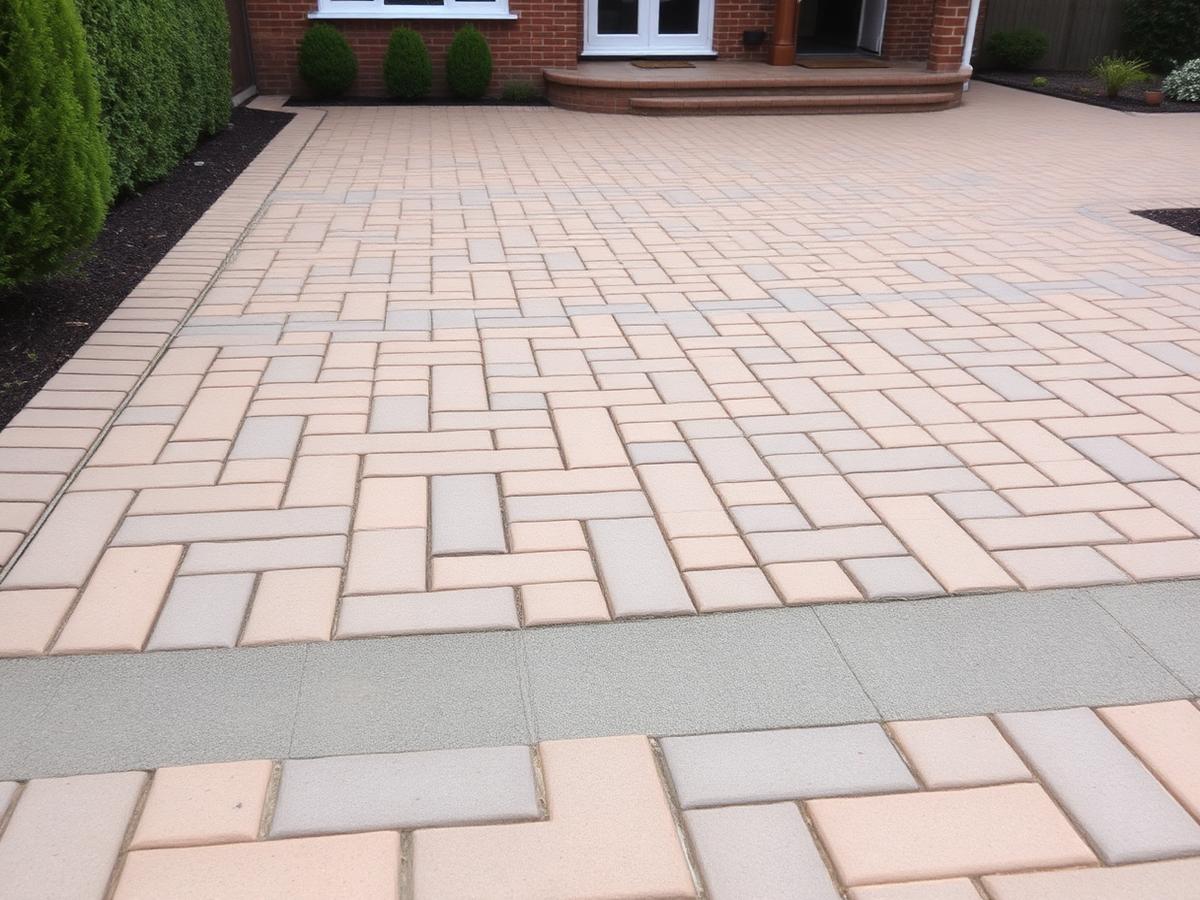
How to tell this is your problem
- A saucer-shaped depression holding water after rain
- Two parallel ruts where the wheels track
- Individual blocks rocking underfoot
- Joint sand disappearing from around the dip
- A dip directly over a manhole, gully or old trench
Repair or replace?
Repair almost always wins with block paving. Full replacement only makes sense where the base has failed across the whole area or you want to change the surface entirely.
Repair options, cheapest first
- 01
Lift, re-screed and re-lay
Blocks in the affected area are lifted and stacked, the laying course re-screeded to level, and the same blocks put back. Colour-matching is a non-issue because the original blocks are reused.
- 02
Localised base repair
Where the dip is over a soft spot or trench, the excavation goes deeper - out to sound ground, back-filled with compacted Type 1 in layers.
- 03
Re-fix the edge restraint
Concrete haunching is re-formed behind the edge course so the field cannot creep. This is often the missing step on drives that keep dipping.
- 04
Re-sand and seal
After any lift-and-relay, kiln-dried sand is brushed in and vibrated home. Sealing is optional and cosmetic.
Why it happens
Uncompacted service trench
Water, gas and drainage trenches that were backfilled loose will settle for years. The dip follows the line of the trench exactly.
Washed-out laying course
Where water runs under the blocks it carries the sharp sand away. The blocks then drop into the void it leaves.
Insufficient sub-base under wheel tracks
Ruts down the driving line mean the base was too thin for the load it is carrying, not that the blocks failed.
Edge restraint failure
Once the edge course spreads, the whole field of paving relaxes outwards and the middle drops.
Cost and time on site
Indicative cost
Localised lift-and-relay is priced by area and is a fraction of a new drive, because the blocks are reused.
Typical duration
A single dip is often a day. Wheel-track ruts across a full drive typically take two to three days.
Every quote is priced after seeing the site. Most dips are a one-day lift and re-lay - send a photo and we will confirm.
Sunken block paving: common questions
- Can the original blocks be reused after lifting?
- Yes, in the vast majority of cases. Blocks are far tougher than the sand bed beneath them and usually only a handful are chipped badly enough to swap out.
- Why is my driveway dipping in one narrow line?
- That is the signature of a service trench. The pipe run was backfilled without compaction and has been settling ever since.
- Will topping up joint sand stop the sinking?
- No. Sand loss is a symptom of water movement under the surface. Topping it up is worth doing, but it will not lift a dip.
- How level should a driveway actually be?
- It should not be flat - a driveway needs a deliberate fall of roughly 1 in 60 to 1 in 80 so water runs off rather than sitting on it.
Services that fix this
Block Paving Driveways
Block paved driveways laid on a proper Type 1 sub-base with kerb restraint.
Driveway Cleaning & Restoration
Deep pressure wash, re-sanding and sealing for block paved and stone driveways.
Related reading: Sinking Block Paving: Why It Happens and What Repair Really Costs
Ready to transform your outdoor space?
Free site visits and no-pressure quotes within a 30-mile radius of Ash Vale - covering Surrey, Hampshire and Berkshire.